Tuesday, January 17, 2012

Unlocking The Solar Power Of Military Bases


Military bases are huge. And they have lots of open space. So much open space, in fact, that bases in Southern California could become solar power generators - contributing up to $100 million per year in revenue to the federal government, according to a new study commissioned at the request of Congress.

The Department of Defense has a huge power bill, some $4 billion per year, according to this story in CleanTechnica that sums up the findings of a year-long study for the military by Virginia-based analytical firm ICF International. Even though 96% of the open space would be considered off limits, the remaining 4 percent is enough to generate 7,000 megawatts, which, CleanTechnica states, is 30 times more power than the bases consume.

The government could receive $100 million in rent payments, reduced cost power, in-kind contributions or some combination thereof, the study states. The military solar could generate enough power to supply 1.75 million homes, according to industry estimates.

However, it's unlikely that all of that 4 percent would be claimed. Much of the land is remote and access to the transmission grid poses significant challenges. That said, about 25,000 acres at military bases in Southern California are "suitable" for development, and about 100,000 acres are "likely" or "questionably" suited for solar development. The researchers assumed 100 percent of the 25,000 "suitable" acres and 25 percent of the "likely" and "questionable" land could be turned over to private solar developers.

Most of the installations already contain one to two megawatts of solar power - and large chunks of property that can't be used for solar. Modern weapons systems and other issues - flash flood hazards, steep slopes and conflicts with native habitat - prevent development of the overwhelming majority of the land.

But covering just 6 percent of the potentially available land would generate enough power to meet the military's 2005 renewable-energy goals, the report states.

Five types of solar projects were considered: rooftops, shaded parking lots; shading structures over unpaved parking lots; and ground arrays.

As CleanTechnica notes, "military bases occupy more than 30 million acres of land, much of it in areas with lots of sun, and they need a secure supply of electricity as a matter of security..."

So, why not use solar? The clean energy would help California reach or exceed its ambitious 33 percent renewables mandate and, when combined with other innovative programs (such as using rights-of way under transmission lines; More on that here,), would put otherwise waste land to productive use.

To unlock that potential, the authors put forth the following recommendations for the Department of Defense:

Work with stakeholders to accelerate construction of transmission lines; develop microgrid technology on the military bases (like this project) and further refine its energy-security goals; provide incentives for military installations that invest in energy technology; and work with the federal Bureau of Land Management (which also leases land to solar companies) to ensure the government is getting fair rents.

Here is a New York Times story on the report.

Photo: Solar array at Fort Hunter by http://www.army.mil/

Monday, January 16, 2012

Hydrogen highway: Demonstrating a fill-up in LA

Dan Neil of the Los Angeles Times shows off the new Honda Clarity fuel cell vehicle. He gives some details about the fuel and shows how this particular vehicle would be refueled. Warning: It takes some time.

This second video explains how the various hydrogen fuel technologies work. Both videos are short.

Friday, January 13, 2012

The Big Bang of Energy Efficiency


I interviewed many financial planners in a newspaper career that spanned three decades, and they all said the same thing: Cutting spending is easier than finding new sources of revenue.

Property owners know this. Power bills are among their biggest expenditures, but also are relatively easy to control. And homeowners want efficient energy and lower bills, according to this survey. So, why isn't more effort put forth in that arena? Presidential candidates are all atwitter about the economy, but I haven't heard one mention the need for energy efficiency. Isn't saving money a bipartisan goal?

This report (log-in required, but here also is a link to a press release) from the American Council for an Energy-Efficient Economy suggests that energy consumption could be slashed up to 60 percent by 2050, saving an average of $400 billion nationwide - the equivalent of $2,600 per household.

The first sentence in the press release reads: "America is thinking too small when it comes to energy efficiency."

Is it ever. If thinking big could net U.S. consumers $400 billion in annual savings, here is an even more mind-blowing number: $16 trillion!. That is the estimated cumulative savings from 2012 through 2050 after paying for energy-efficiency upgrades, which admittedly would require up-front investment in most cases. After all, equipment has to be purchased and workers paid to install it.

Still, it would lead to an economic boost, giving families more money to spend and businesses more cash to invest - leading to at least 1.3 million new jobs by 2050. Wouldn't a Manhattan Project devoted to energy efficiency and clean energy make sense?

Energy efficiency is a gift that keeps on giving: The savings continue after the initial costs are recouped, often in as little as two years. the authors cite evidence that equates energy-efficiency upgrades to a return of 17 percent to 25 percent on investment. What other (legal) investment reaps those kinds of gains?

Deutsche Bank reaffirms that here, concluding after exhaustive research that energy-efficiency upgrades are a safe investment. A bank executive said in a study cited by CleanTechnica that, "...Savings alone were sufficient to fully support loans for energy efficiency capital improvements." As a follow-up, this piece in Forbes says loans that fund energy-efficiency retrofits could make money for banks.

Those kinds of benefits are often ignored when assessing the power of energy efficiency, experts say. "Unfortunately, these non-energy benefits from energy efficiency measures are often omitted from conventional performance metrics," the authors of the ACEEE study contend.

And let's not forget the environmental and other benefits. "There is a strong historical record that energy efficiency can provide perhaps the largest single wedge of GHG emissions reductions," the study notes. The report also cites lower maintenance costs after the upgrades.

Both studies reinforce our belief that energy efficiency is the low-hanging fruit of the clean-energy movement. Our nonprofit works with local governments to reduce energy consumption, and has helped Valley communities realize energy savings of more than 16 million kWh.

That's a big deal in this era of shredded budgets and staff cuts. Maybe we can help preserve someone's job by shaving thousands off a power bill.

That's not to say that progress isn't being made. President Obama and former President Bill Clinton tag-teamed on this $4 billion plan, more businesses and organizations (check out this link) are discovering the power of energy efficiency, and California is considering instituting the nation's first energy-efficiency standards for battery chargers, which waste enough electricity to power a city the size of Bakersfield, according to this story in the San Jose Mercury News.

California is the nation leader in energy-efficiency, but other states are nipping at its heels. In Tennessee, officials are using some money from a $24 million settlement with the TVA to fund energy-efficiency programs. Minnesota also is getting in on the act. More on that here and here.

Individual states, businesses and groups are focusing on energy efficiency because they recognize the benefits to their entities. But a unified campaign is lacking, although this gives me hope. Saving energy saves money, creates financially stronger households and businesses and is good for the environment. It's time to get serious about it.

Wednesday, January 11, 2012

Solar-friendly designs could aid renewable energy efforts


A new report contends that designing solar-friendly homes would help spur the installation of alternative-energy systems.

The study entitled, "Solar Ready: An Overview Of Implementation Practices," by the respected National Renewable Energy Laboratory, argues that solar-ready design features, if they are implemented early in the design process, are typically "low or no cost," thus making it easier and cheaper to install solar-energy systems later on.

Authors Andrea Watson, Linda Giudice, Lars Lisell, Liz Doris and Sarah Busche estimate that some 7.8 million privately owned houses were finished in 2010. "These homes, if not compatible with solar technology, represent a large barrier to widespread solar deployment," they write. "Once a structure is built, structural and other solar access issues can prevent a solar project from being cost effective, and, in some cases, can make it entirely unfeasible."

In particular, the authors note that rooftop integrity and obstructions (such as vents), along with improper placement of shade trees, can restrict opportunities for adding solar power later. The researchers say solar-ready design is crucial if photovoltaic (PV) or solar hot water (SHW) technologies are to be installed during the building’s lifespan.

"Solar ready also allows owners to take advantage of a changing energy market," they write. "The economics for installing solar on a new building are not always compelling, but, in the future, that picture could change with rising electricity prices and/or falling solar technology costs. . . Building a home or commercial building that is not solar ready exposes owners to the risk of not being able to take full advantage of future economic scenarios for solar electricity and hot water. "

Rooftops should be strong enough to accommodate solar panels, the authors suggest, and vents and other obstructions should be grouped in one spot. In addition, architects and builders should consider landscaping that won't reduce the effectiveness of solar.

Positioning is key in solar installations, so preparing beforehand is important. This is from the report: "A 10-kilowatt (kW) PV array in Golden, Colorado, facing south and tilted 25° can be expected to produce 14,304 kW hours (AC) per year with an annual energy value of $1,201.00. . . A west-facing system will produce 10,999 kW hours (AC) per year with an annual energy value of $923.92. This represents a 16% to 23% reduction in PV production and cost savings when oriented 90° away from south."

Likewise, designing for solar water heating saves money later. The study calculates that mounting pipes, vents and panels to accommodate solar water heating during construction is 66 percent cheaper than installing them afterward.

So, how do local governments encourage solar-ready development? The authors analyze three methods: legislation, certification programs and stakeholder education. Let's look at them individually:

1/ Legislation

Several local jurisdictions have policies in place, but their effectiveness is hard to gauge. Policies can include mandating builders offer solar to their customers, adding it to green building codes, offering roof warranties that allow for new solar systems, and providing incentives to developers.

2/ Certification

Certifications could be incorporated into green-building programs or offered individually. Certification guarantees a certain level of quality, helps the property stand out from the competition and is a measurable metric. However, it doesn't guarantee installation of the solar system, and could end up rewarding property owners anyway.

3/ Stakeholder education

Education programs must reach a diversity of people, and the authors say a combo of solar-ready legislation and an educational campaign could be effective. They cite a Boston program as evidence. The city offers developers an integrated design and solar training in conjunction with a solar-ready requirement.

Whichever approach is used, the authors write that they hope it promotes more solar development in the United States. “With millions of new buildings constructed each year in the United States, solar ready can remove installation barriers and increase the potential for widespread solar adoption."

Building a sustainable-car market with 8 horses

Jim Kor could design great heavy machinery and standard automobiles.

But he wanted something more, something sustainable.

What he came up with is an 8 horsepower car he calls the Urbee. His crew designed it by taking what he calls the "long view," looking for ways to reduce impact while providing people a way to continue their car-centric pursuits. He said that now there are about 1 billion vehicles on the road.

"By mid-century, there could be almost 2 billion," Kor said in a presentation at the State of Green Business Forum in Chicago early in 2011. "This could lead to global ecological catastrophe."

Reducing smog

Perhaps. Two times the number of internal-combustion engines burning fossil fuels could smoke the skies, adding dangerously to the already high carbon content of the atmosphere. But many besides Kor are engineering concerted efforts to subvert that scenario. A number of those projects found their way to the North American International Auto Show in Detroit, the Sturgis (for you biker fans) of U.S. car shows.

As never before, designers and innovators are looking to engineer the automobile to run on something more than a gallon of fuel every 10 to 12 miles. Not that there's anything wrong with awful mileage, within reason. There are quite a few cars far beyond my reach that I'd love to have in my stable.

Mercedes joins the game

Mercedes-Benz, which is hardly known for its fuel-sipping ways, came out with several models of interest. The most obvious and different looking is the Smart pickup, which runs on a 55 kilowatt magneto-electric motor, powered by a 17.6 kWh-capacity lithium-ion battery pack, according to Ben Coxworth, a reporter for gizmag.com.

"The Subaru Brat-like mini rear cargo bed definitely gave it a unique car-truck-combo appeal ... or repulsion, depending on the observer," Coxworth writes.

Mercedes also debuted its E300 diesel hybrid, which writes Sebastian Blanco of autoblog.com, is expected to get 45 miles per gallon, while the gas-electric E400 Hybrid is expected to get 27 mpg.

Sailing the autobahn

Blanco says the E-Class hybrids use a combination of lithium-ion batteries, regenerative brakes and the ability to "sail" to save fuel. "Sailing here means that, at speeds of up to 100 mph, the combustion engine can switch off while the electric motor keeps the car moving," he says.

Mercedes maintains its traditional horsepower with 231 for the E300 and 333 for the E400.

That's not super green but far better than most luxury performance sedans I occasionally dream of owning. Here's a post I wrote while still business editor of the Fresno Bee about perhaps my ultimate ride, the Audi A8, driven by Jason Statham in "Transporter 3." Fuel economy: 16 mpg, according to the U.S. Department of Energy's fueleconomy.gov. The car is amazing, and I can just imagine shortening the ride from my sister's house in Hermosa Beach from four hours to two plus, screaming down 99 in the pitch black sharing the road with nobody but truckers.

Building a better Urbee

Kor's venture is not yet ready for prime time. His base is in a Winnipeg, Manitoba shop, and he could use some investors. The Urbee is a hybrid that's engineered to slip through the wind with the least amount of resistance and expended power. He says he wants to make it simple and patterned it after the easy-to-build-and-repair Ford Model T and Volkswagen Beetle.

Kor says the majority of what's produced today is unsustainable, and he'd like to help change that. "The solution resides within all of us," he says.

Cars are an obvious entry point to sustainability. They're full of fantasy and style, as Kor says. Make the next Aston Martin DB5 ("Goldfinger" version) in green and watch the industry evolve overnight, or something like that.

Ford electrifies Fusion

Even Ford is getting into the alternative transportation game. Globalenergywatch.com reports that the automaker's Fusion is the first sedan to offer gasoline, hybrid and plug-in hybrid versions this year.

"Derrick Kuzak, Ford's group vice president of global product development tells the site: "We brought our global teams together around a blank slate with the charge to develop a mid-size car with ground-breaking design and jaw-dropping fuel economy."

Ford's entry continues to crowd the field, adding to Chevy's Volt, Nissan's Leaf, Tesla's Roadster and upcoming Model S and various other makes.

EVs stalk commercial market

It's hard to say how the segment will fare with consumers, who fret about range and recharge speeds. But energy costs, especially with continued uncertainty of supply from the Middle East, drive development of electric and hybrid vehicles. And don't expect any sustained declines in fuel prices.

Ulicia Wang of earth2tech.com reports another trend that could sneak up and grab a bunch of market share: commercial trucks. VIA Motors, headed by former General Motors Chairman Bob Lutz, retrofits new trucks with electric/gas drive-train capable of 402 horsepower. The first 40 miles is electric with a range of 400 miles using the gas engine.

Wang says the company plans target corporate clients and later consumers.

Green car rental

And there's the Venice Beach, Calif.-based outfit MPG Car Rental, which rents a fleet of high-mpg vehicles like the Honda Insight and Chevy Volt to people in Los Angeles. "MPG is helping reduce our carbon footprint and bring an affordable green alternative to car rental," the company says.

More like-minded companies will spring up. Their success or failure will help chart the course of the electric-vehicle segment. I'm betting such entrepreneurship, high gas prices and an expanded EV and hybrid lineup will pull in significantly more believers.

And that's not even counting the electric motorcycle market.

Photo: gizmowatch.com

Reducing business costs through environmental stewardship


Businesses can save green by going green. Find out how from 9-11 a.m. Jan. 19 at the Small Business Administration district office in Fresno. The address is 801 R St. Suite 201, Fresno, CA. 93721.

There, business owners can learn more about REACON (Recycling Energy Air Conservation), a program administered through the Greater Stockton Chamber of Commerce's Green Team. The workshop is free, but space is limited. RSVP at fferral@stocktonchamber.org.

Here is a link to the REACON web site.

REACON has as goals recycling, energy conservation, reduction of air pollution and water conservation. Members of the Stockton chamber's Green Team help businesses throughout the Valley implement green practices, and help them them get certified as "green."

Businesses can become green through a whole host of measures: from simple ones such as affixing signs encouraging water conservation and changing irrigation schedules to implementing "no idle" policies 0n vehicles to more ambitious plans such as installing solar energy systems.

Here is more on REACON.

Tuesday, January 10, 2012

Taking a carbon-reduction cue from Europe's greenest city

Hamburg is the world's most beautiful city.

Or at least that's what my friend and former co-worker Alex Schwenkenberg would say followed by, "Take a look." And he'd pull up several shots of the Germanic cityscape.

Whatever its standings in the looks department, Hamburg, which has a population of about 1.8 million, does have an attribute few question. It stands as one of the world's greenest cities and offers an example of how other cities could improve their carbon footprint and livability.

Many U.S. cities have taken up the green challenge -- from California to Texas and up in Maine. It involves embracing arcane concepts like sustainability, energy efficiency and benchmarking greenhouse gas production. But solutions are relatively simple and noncontroversial.

Urban centers draw young people

Young people are the key. They're the next generation of real estate buyers and leaders, and they're increasingly looking to settle in urban centers rather than the suburbia preferred by their parents, says Michael Freedman, urban planner, futurist and founding partner at San Francisco-based Freedman, Tung + Sasaki. They want work close to home and socialize. They don't want to spend 10 percent to 20 percent of their waking hours stuck in traffic.

And they want greener vistas, cleaner air and a better overall environment.

Hamburg's leaders caught the sustainable bug sometime after the fall of the Berlin Wall in 1989. The city aims to reduce its carbon dioxide emissions by 40 percent in 2020 and 80 percent by 2050. It's just wrapping up a year as Europe's greenest city, a designation that passes to Vitoria-Gasteiz, Spain. The European Green Capital award is issued by the European Commission as a means to get cities to inspire each other and share best practices, "while at the same time engaging in friendly competition."

Hamburg's CO2 savings

Energy-saving measures by 810 Hamburg businesses keep about 219,000 tons of carbon dioxide from the atmosphere annually and the amount of energy expended on heating facilities "has dropped by 40 percent compared with 1990, causing a 45 percent reduction in CO2 emissions," according to city officials.

The city also is encouraging sustainable practices and development. Its HafenCity project, which has taken docks and old industrial land in the heart of Hamburg, epitomizes the trend. The massive redevelopment project is being engineered to transform 387 acres on the Elbe River into the most energy efficient residential, business and arts sector in the city. Design is compact yet has open space, encouraging living, working and entertainment.

Hamburg is hardly the Lone Ranger in green-minded redevelopment. Yet, others struggle. Oakland's been trying to jump start the project to revamp the 330-acre old Oakland Army Base for the past decade. Other cities, including Fresno, have been trying to redevelop their urban centers for decades. Some have been successful. Some haven't.

Sustainable makes cents

As the American Society of Landscape Architects says: "Urban development should be guided by a sustainable planning and management vision that promotes interconnected green space, a multi-modal transportation system, and mixed-use development."

In other words, people have to like it, and they'll like it better if it's sustainable.

Amory Lovins at the Rocky Mountain Institute says going sustainable and green actually saves money and provides economic benefits. He calls it "synergistic bundling."

San Antonio's Mission Verde

San Antonio has embraced the concept, launching it's Mission Verde Sustainability Plan  to create jobs through green technology and infrastructure. "Saving energy saves money," the plan says. "Renewable energy creates economic self‐reliance."

It will be interesting to see how San Antonio does in the heart of Texas oil country. The city says it wants to set an example for others to follow.

In the next several months, my organization will be working with a handful of San Joaquin Valley cities to create energy action plans with realistic goals that actually save energy and money and reduce green house gases. The scale will be nowhere near Hamburg's or San Antonio's, but it may save some jobs just by replacing inefficient lighting and doing other more inventive stuff like adding solar and fuel cells to city buildings.

Guiding sustainable projects

A friend of mine at a small Valley community who has been working with me implementing energy efficiency stimulus grants for the past year or so just landed a job in the Bay Area. She'll be guiding a city's climate plan and making a difference.

A little here and there. Like European Commission says, Europe is an urban community and must make changes to become more sustainable. California and 49 other states must do the same.

And I believe it will happen. A little at a time.

Photo: Hamburg's Alster Lake

Wednesday, January 4, 2012

Jail Facilities Lock Up Solar Power


My friend half jokingly refers to the inland portion of Central California as "Valley of the Cons" because prisons employ so many people here. The state Department of Corrections is listed as major employers in Madera, Fresno, Kings and Kern counties, according to the state Employment Development Department.

Coalinga, Corcoran and Chowchilla are home to some pretty large correctional facilities. Then there are the smaller county jails. Both kinds of lockups face the same dilemma: shrinking budgets. Maybe Solar Valley can meet Valley of the Cons. Sixty miles to my north is Merced County, where officials thought up a way to slash power bills, contribute to the state's ambitious 33 percent renewables mandate and make a few bucks. They signed a deal with Siemens to put solar panels at a county jail. More on that here.

The idea of using solar energy at prisons isn't new. In 2001, GreenBiz.com wrote about this project in Alameda County, and state officials are planning solar panels at prisons in Delano and Tehachapi, both in Kern County (also Blythe and Lancaster, according to this story ).

The solar array in Merced County will cover 4.5 acres, offset 75 percent of the power usage at the John Latorraca Correctional Facility and Iris Garrett Juvenile Justice Correctional Complex, will lead to an estimated $14 million in energy savings over 25 years and could create $9 million of positive cash flow over the same 25 years. It also will eliminate about 1,000 tons of CO2 emissions when combined with lighting upgrades implemented by Siemens.

The county will receive solar incentives totalling $1.5 million over five years, and is eligible for PG&E's capital improvement rebate.

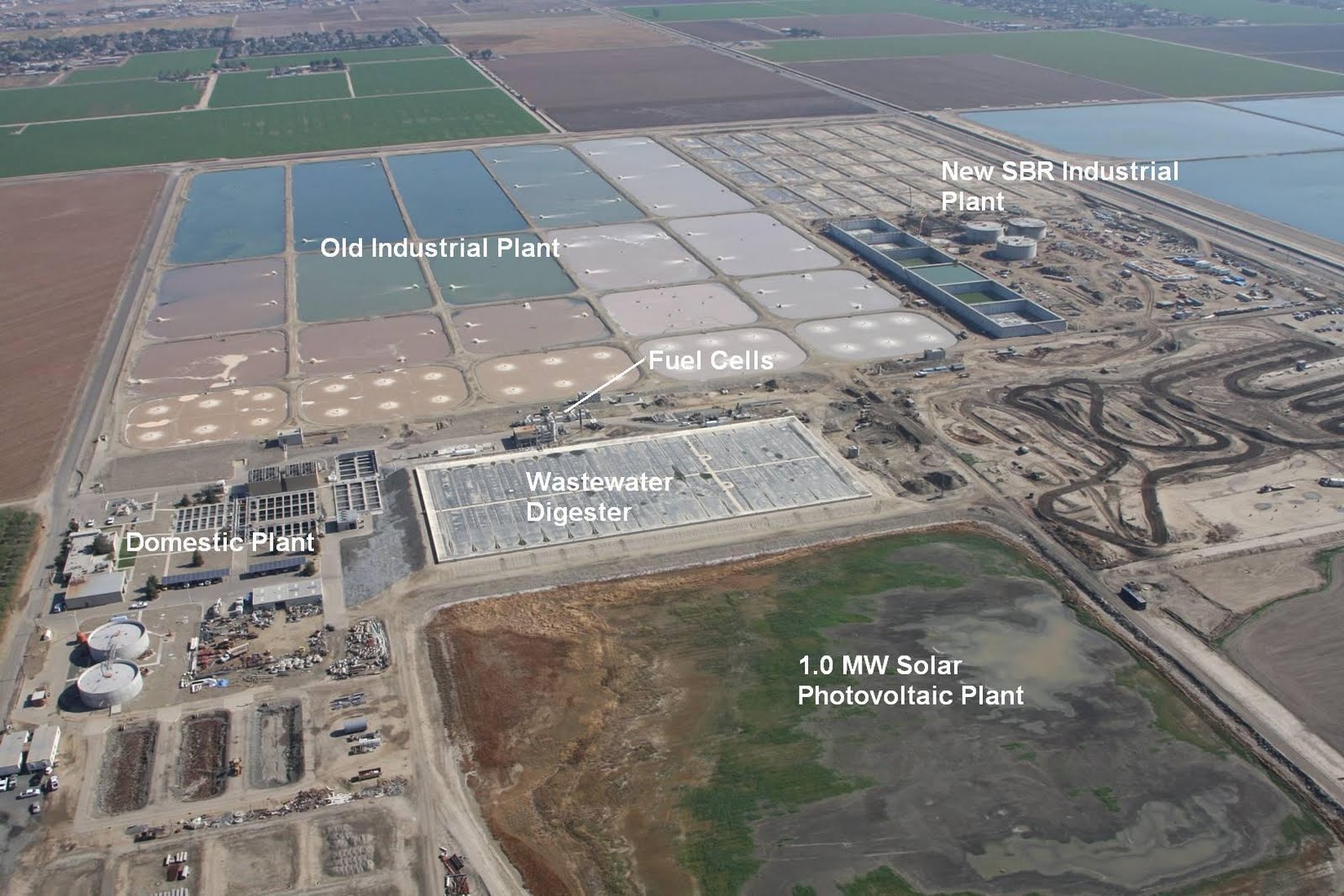
Powering jails with solar energy is only one way that local governments can slash utility costs. Increasingly, cities and counties are using solar energy to save money at their biggest energy hogs: water treatment plants.

SunPower Corp. has finished deals at water operations in Los Angeles, Riverside and Sacramento counties, according to this article in pv Magazine, but they are hardly isolated cases. Similar connections are in place in Parlier, Tulare and Madera in the San Joaquin Valley. Learn more here.

The San Joaquin Valley, where I sit, is blessed with lots of sun. But that sun also creates triple-digit temperatures in the summer, which leads to high power bills and high energy use. Utilizing the rich solar resource to attack the high power bills makes sense here. That's why officials at UC Merced, which has a top-notch solar research program, unofficially dubbed this region "Solar Valley."

That certainly sounds better than "Valley of the Cons."

Photo: Aerial view of Tulare wastewater treatment plant

Tuesday, January 3, 2012

Researchers Invoke Thomas Jefferson In Energy Study


Subsidies for clean energy have been getting a bad rap lately, but the government has used taxpayer money to boost energy since the early years. In fact, subsidies fueled the innovation that drove this nation's growth, two authors note in a report entitled, "What Would Jefferson Do: The Historical Role of Federal Subsidies in Shaping America's Energy Future."

Venture capitalist Nancy Pfund and Yale graduate student Ben Healey say federal subsidies on fossil and nuclear fuels dwarf the comparative pittance spent on renewables, which should receive more attention: "Overall, what we find, in contrast to much of today’s headline-grabbing rhetoric, is that today’s government incentives for renewable energy pale in comparison to the kind of support afforded emerging fuels during previous energy transitions," they write.

The authors embark on a historic journey, citing the roles of energy subsidies in the early days, through the Westward Expansion and Industrial Revolution, to the Great Depression and on to post World War II. And they note the current stutter-step advancement of renewable energy from "the margins to mainstream."

They said land grants - which have to be classified as a subsidy - helped spur timber as an early fuel source, and that later legislation benefited the coal industry. The authors write, "As the railroads grew, 'The high price of coal and iron … created a furor … amounting almost to a mania, and the files of both houses [in Pennsylvania were] filled with bills for chartering new Coal and Iron Companies."

Then came oil and gas - and this from their study: "...from a 1990 report of the General Accounting Office: … The marginal effective federal corporate tax rates—i.e., the tax rates on genuinely incremental investments—for domestic petroleum production are already among the lowest for a major industry, due to the effects of existing tax incentives. "

Federal oil and gas subsidies alone have averaged $4.9 billion annually in 2010 dollars from 1918 to 2009, the authors suggest. By contrast, nuclear averaged $3.5 billion in subsidies yearly from 1947 to 1999, biofuel averaged $1 billion in subsidies each year from 1980 to 2009 and solar averaged only $0.37 billion in subsidies annually between 1994 and 2009.

The really big cost

(The oil subsidy figure does not include the cost of energy security. To quantify that, the researchers quote Roger Stern, an economic geographer from Princeton University who calculated the cost of keeping aircraft carriers in the Persian Gulf from 1997 to 2007 at $7.3 trillion.

"Because carriers patrol the gulf for the explicit mission of securing oil shipments, Stern was on solid ground in attributing that cost to oil," Pfund and Healey state. )

Not surprisingly, the authors suggest that "a strong case can be made" that the federal government needs to continue supporting subsidies to help drive the next generation of energy technology.

"Such incentives were instrumental in overcoming the risk factor and establishing the current petroleum industry, and they are as necessary now for the alternative fuel businesses as they
were 100 years ago to overcome high initial startup costs, minimize the risk associated with new
industries, and signal to taxpayers support for these industries."

The researchers point out that combustion turbines were once uneconomic, and government support helped make them mainstream: "That kind of innovation was surely a subsidy to the natural gas industry," they wrote, "But we can also agree that America as a whole is better off having access to the resulting technology. . . Why should current renewable technologies face different standards?"

The authors end their study by offering an answer to their cover question: WWJD? What would Jefferson (who inspired the Bill of Rights and was the nation's third president) do? Here's more on Jefferson's role.

The authors contend that Jefferson would "support emerging technologies to drive innovation, create jobs, protect our environment, enhance our national security in a time of rapid change, and to further a distinctly American way of life in which resources once thought to be endless are replaced by ones that actually are."

(Photo by Matthew Maaskant)

2012's Best Investment Opportunity


This link goes to a blog that highlights savings (cost and energy) through energy efficiency. One business is investing $10 million to save $4 million ANNUALLY through energy-efficiency measures. Even a simple Journalism major like myself understands those numbers: a 2-year payback and then all profit afterward.

If your resolution is to make smart investments this year, consider energy efficiency.

(photo of transmission line by Christa Richert)